AI readiness assessment for small and mid-size businesses
An AI readiness assessment checks whether a business has what it needs to use AI safely and get a return from it: clear goals, usable documents, the right tools, trained people, repeatable processes and rules for data. This free AI readiness assessment asks 19 questions, scores you out of 100 in those six areas and gives you 3 to 5 next steps, each linked to a guide. It is built for teams of 5 to 200 people, and your answers never leave your browser.
Updated
Answer for how your business works today, not how you plan it to work. There are six short parts, and you can go back and change any answer.
Nothing you answer is stored or sent by this assessment: the score is calculated in your browser, there is no form, no email and no cookie, and closing the page deletes everything.
See all 19 questions and what each answer scores
Every question has four answers, worth 0 to 3 points. A dimension's score is its points as a share of the maximum, from 0 to 100.
Strategy and goals
Whether you know what AI is for in your business, who owns it and what you will spend.
1. What do you want AI to do for your business?
- We haven't thought about it yet (0 points)
- Something general, like saving time (1 point)
- A short list of tasks or problems it should help with (2 points)
- One to three goals with a number, such as replying to every enquiry within an hour (3 points)
2. Who owns AI work in the business?
- Nobody (0 points)
- The owner or a manager, when there is time (1 point)
- A named person, but with no time set aside for it (2 points)
- A named person with time for it every week (3 points)
3. What have you set aside for AI this quarter?
- Nothing (0 points)
- Free tools only (1 point)
- A monthly budget for tools (2 points)
- A budget for tools and for setup or training, with a date to review what it delivered (3 points)
Data and documents
Whether the information an AI would work from is written down, current and in one place.
4. Where do your price list, service descriptions, FAQs and procedures live?
- Mostly in people's heads (0 points)
- Scattered across emails, desktops and paper (1 point)
- Mostly in one shared drive, partly out of date (2 points)
- In one shared drive, up to date, with someone responsible for each document (3 points)
5. How are your customer, order or client records kept?
- On paper or in personal notebooks (0 points)
- In spreadsheets kept by different people (1 point)
- In one system (CRM, booking, store or practice software), with gaps or duplicates (2 points)
- In one system that is clean enough to export and trust (3 points)
6. If an AI answered a customer's question from your documents today, would the answer be right?
- No, the documents it would need don't exist (0 points)
- Often not: prices or policies have changed since they were written (1 point)
- Mostly, with some gaps (2 points)
- Yes, we update the documents whenever something changes (3 points)
Tools and systems
Whether your team shares one AI assistant and your apps can connect to each other.
7. Which AI assistant does your team use for work?
- None (0 points)
- Each person uses whatever free tool they like (1 point)
- One assistant, with some people on a paid plan (2 points)
- One assistant on a business plan for everyone who needs it (3 points)
8. How do your main apps (email, calendar, CRM or bookings, store, accounting) fit together?
- Mostly paper, or desktop software with no online access (0 points)
- Online apps, but we don't know whether they connect (1 point)
- Online apps that connect to Zapier, Make or n8n, or have AI built in (2 points)
- Already connected, with at least one automation running (3 points)
9. Who looks after your software accounts and admin access?
- Nobody in particular, and some logins are shared (0 points)
- Whoever has time (1 point)
- One named person, part time (2 points)
- A named person or IT provider, with every account and admin login written down (3 points)
People and skills
Whether your team uses AI, has learned to use it well and feels okay about it.
10. How many people on your team use AI for work each week?
- Nobody (0 points)
- One or two people (1 point)
- About half (2 points)
- Most of the team, as part of their daily work (3 points)
11. What AI training has the team had?
- None (0 points)
- Self-taught, from videos and trial and error (1 point)
- A few people have had some training (2 points)
- Everyone who uses AI has been trained on our tools and rules, for their own role (3 points)
12. How does the team feel about AI at work?
- Worried, or against it (0 points)
- Mixed, and we rarely talk about it (1 point)
- Curious, and a few people share tips (2 points)
- Keen: people share prompts and results, and know what AI will and won't be used for (3 points)
Processes worth automating
Whether your repeated tasks are known, measured and done the same way each time.
13. Do you know which repeated tasks take the most time each week?
- No (0 points)
- A rough idea (1 point)
- Yes, there is a written list (2 points)
- Yes, a list with the hours each one takes and the money at stake (3 points)
14. Are those tasks written down step by step?
- No, they live in people's heads (0 points)
- A few notes here and there (1 point)
- The main ones are documented (2 points)
- All of them are documented, with an owner for each (3 points)
15. Is each of those tasks done the same way every time?
- Everyone does it differently (0 points)
- Mostly the same, with many exceptions (1 point)
- The same steps, with few exceptions (2 points)
- The same steps, with a check before anything goes to a customer (3 points)
Risk, privacy and policy
Whether you have rules for data and AI, and a person checking what goes out.
16. Do you have written rules for using AI at work?
- No (0 points)
- Spoken rules only (1 point)
- A written page that not everyone has read (2 points)
- A one-page policy everyone has read, listing the approved tools (3 points)
17. What happens with customer, patient or client data in AI tools?
- We don't know; people may paste it into free tools (0 points)
- We tell people not to paste it, but nobody checks (1 point)
- It only goes into business plans that don't train on our data (2 points)
- Business plans only, plus a written list of what never goes in and who to ask (3 points)
18. What happens before AI-written work reaches a customer?
- It can go out without anyone reading it (0 points)
- It depends on the person (1 point)
- A person reviews anything a customer will see (2 points)
- A person reviews it, and we know what to do if something wrong goes out (3 points)
19. Do you know which data laws and professional rules apply to the data you would put into AI (for example GDPR, HIPAA or your professional body's rules)?
- No (0 points)
- We've heard of them, but haven't checked (1 point)
- We know which apply, but haven't checked our AI tools against them (2 points)
- We know which apply and have checked our AI tools' business terms against them (3 points)
What this AI readiness assessment framework measures
The assessment scores six dimensions with three or four questions each. We built them from three published frameworks, read on their own pages on October 28, 2026, and kept only what a business of 5 to 200 people can act on this quarter.
| Our dimension | Cisco AI Readiness Index | Microsoft AI Readiness Assessment | NIST AI RMF |
|---|---|---|---|
| Strategy and goals | Strategy | Business Strategy, AI Strategy & Experience | Map |
| Data and documents | Data | Data Foundations | Map |
| Tools and systems | Infrastructure | Infrastructure for AI | Govern 6 (third-party software) |
| People and skills | Talent, Culture | Organization & Culture | Govern 2 (accountability and training) |
| Processes worth automating | No separate pillar (closest: Strategy) | No separate pillar (closest: AI Strategy & Experience) | Map 1 (context) |
| Risk, privacy and policy | Governance | AI Governance & Security | Govern, Measure, Manage |
- Cisco AI Readiness Index. Six pillars (Strategy, Infrastructure, Data, Governance, Talent and Culture) measured on 49 indicators (Cisco methodology). Its first edition surveyed 8,161 business leaders at organizations with 500 or more employees (Cisco 2023 report), so its Infrastructure pillar is about compute, networks and power. A small business rents all of that as software, so our tools questions ask about the AI assistant, the apps and who holds the logins.
- Microsoft AI Readiness Assessment. Seven pillars, from Business Strategy to Model Management, in a multiple-choice assessment on Microsoft Learn (Microsoft). We left out Model Management: training and running your own models is not where a 5 to 200 person business starts.
- NIST AI Risk Management Framework. A voluntary framework released on January 26, 2023, built on four functions: Govern, Map, Measure and Manage (NIST). Our risk questions are the small-business version of its categories (AI RMF Core): written rules (Govern 1.2), the laws that apply to your data (Govern 1.1), what goes into outside AI tools (Govern 6), and a person who checks output and knows what to do when it goes wrong (Measure 3, Manage 4).
The processes dimension is our own addition. None of the three frameworks asks it on its own, but for a small team it decides where AI pays off first: a task that is repeated, timed and done the same way each time is one you can hand to AI and check.
How this AI readiness assessment tool scores you
Every answer is worth 0 to 3 points, from "not in place" to "in place and owned". That follows the way Cisco scores each indicator, from no deployment to full deployment.
Answers
Each of the 19 is worth 0, 1, 2 or 3 points
Dimensions
Points as a share of the maximum, from 0 to 100
Overall
The plain average of the six dimensions
Level
Cisco's cut-offs, capped when risk is under 31
Steps
3 to 5, picked from your weakest dimensions
- Equal weights. Cisco's 2023 report weights its pillars (Infrastructure 25%, Data 20%, Strategy, Governance and Talent 15% each, Culture 10%). Those weights fit large companies that build their own AI infrastructure, so we weight our six dimensions equally.
- Levels. The cut-offs are Cisco's: 0 to 30, 31 to 60, 61 to 85 and 86 to 100. The number is not comparable with Cisco's benchmark: the questions are different, and we collect no answers, so there is no average to compare with.
- One cap. If your risk, privacy and policy score is under 31, your level stops at Building foundations, whatever the overall score says. Automating before you have data rules is the mistake that is most expensive to undo.
- Steps. Your three weakest dimensions always get a step, and up to two more do when they score under 75. A dimension at 50 or below gets its basic step, above 50 the next one. Equal scores go in this order: risk, strategy, data, processes, people, tools. A risk score of 50 or less always makes the list.
A sample result: a 25-person online store
We ran three made-up businesses through the assessment's own scoring code on October 28, 2026, answering each question the way such a business plausibly would, and logged every answer with the reason for it. This is one of them: Northfield Goods, an invented online store with 25 people on Shopify.
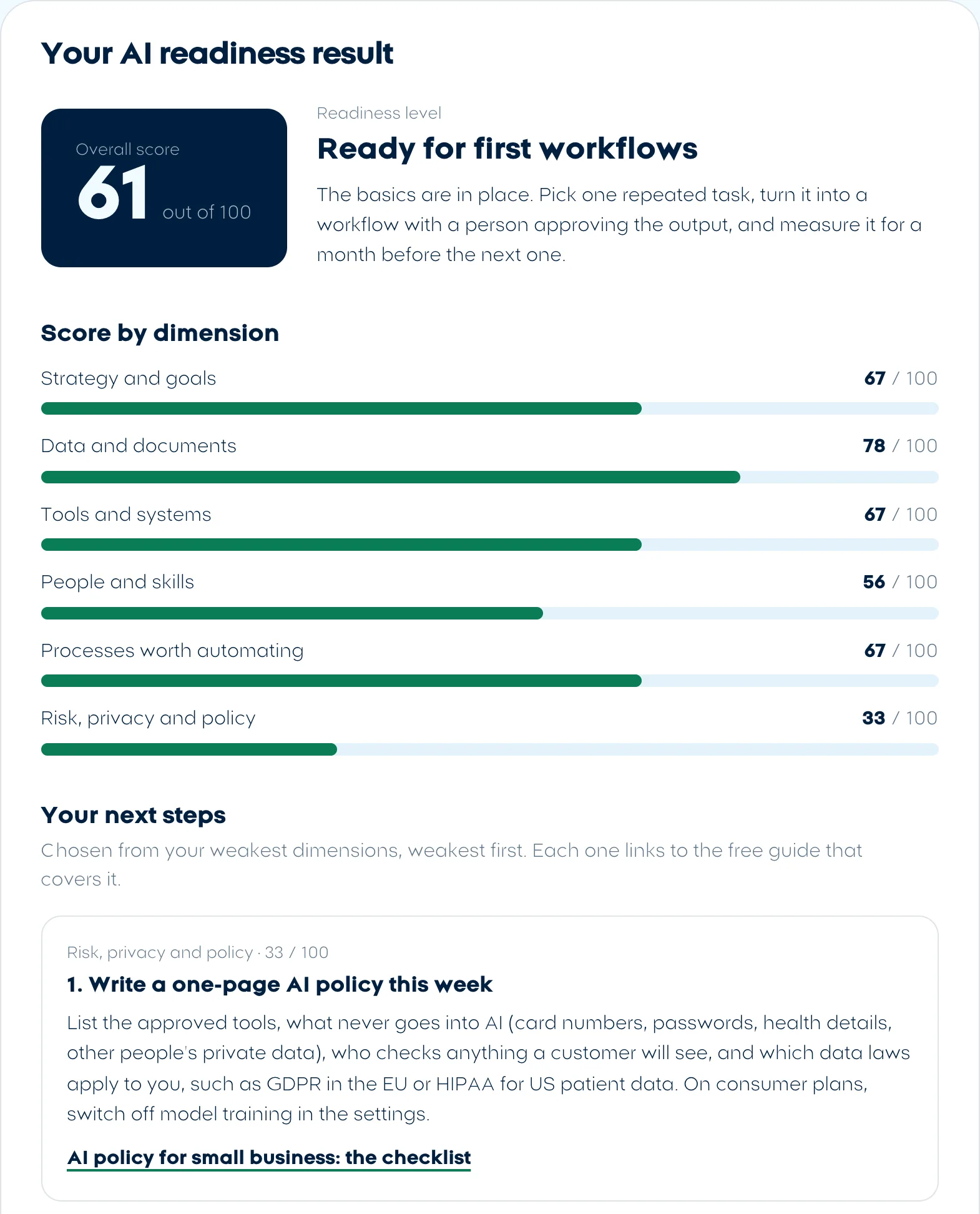
| Dimension | Score |
|---|---|
| Strategy and goals | 67 |
| Data and documents | 78 |
| Tools and systems | 67 |
| People and skills | 56 |
| Processes worth automating | 67 |
| Risk, privacy and policy | 33 |
| Overall | 61: Ready for first workflows |
The store picked middle answers for most questions, but staff paste customer emails into ChatGPT to draft replies, nobody checks it, and AI product descriptions sometimes go live unread. So risk scores 33 and its policy step comes first, even though the overall score reaches the third level:
- Write a one-page AI policy this week (risk, privacy and policy: 33)
- Name an AI champion and share what works (people and skills: 56)
- Turn your goals into a one-page AI plan (strategy and goals: 67)
- Score your tasks and launch the top one (processes worth automating: 67)
- Pick one automation platform and map your apps (tools and systems: 67)
The other two test businesses came out like this:
| Made-up business | Overall | Level | Weakest dimension | First step |
|---|---|---|---|---|
| Dental clinic, 6 people | 37 | Building foundations | Risk, privacy and policy (33, tied with three others) | Write a one-page AI policy this week |
| Online store, 25 people | 61 | Ready for first workflows | Risk, privacy and policy (33) | Write a one-page AI policy this week |
| Accounting firm, 120 people | 82 | Ready for first workflows | People and skills (56) | Name an AI champion and share what works |
Did the steps make sense? For the clinic, patient data meets free tools with only a spoken rule, so a policy, a goal, training and one business-plan assistant come before any automation; its five steps cover every dimension except processes. The accounting firm already has rules, documents and procedures, and its gap is people: seniors are worried about quality, so it gets three steps, with people first. These answers were invented, so the run tests whether the rules pick sensible steps, not how real businesses score.
What to do at each readiness level
The level tells you what kind of work comes next. The steps in your result tell you where to start.
0 to 30: Getting started
AI is not part of how the business works yet, which is a normal place to start. Spend the next 30 days on three things and buy nothing else yet:
- One assistant for the whole team, on a business plan if anyone handles customer data.
- One page of rules: approved tools, what never goes in, who checks output.
- Five timed tasks, so you can prove later what AI changed.
31 to 60: Building foundations
Some people use AI, but goals, documents or rules are missing, so results depend on who is using it. Fix your two weakest dimensions before you automate anything a customer will see, and give AI work one named owner.
61 to 85: Ready for first workflows
The basics are in place. Pick one repeated task, build it as a workflow with a person approving every output, and measure it for a month before you start the next. The AI automation guide's worksheet helps you pick the task.
86 to 100: Ready to scale
Goals, data, people and rules are in place. Add automations one at a time, review each one every quarter, and get a second opinion on anything that touches money, health or client records.
Frequently asked questions
Is a free self-assessment enough, or do we need an AI consultant?
For most small teams, a self-assessment and the steps it suggests are enough to start. Bring in outside help when an automation will touch money, health or client records, or several systems at once, and give them your printed result as the brief.
How often should we retake the assessment?
Every 90 days, or after a big change such as a new tool, a new hire in charge of AI or a new rule that applies to your data. Print each result so you can see which dimensions moved.
Does the score compare us with other businesses?
No. We don't collect answers, so there is no average to compare with, and the level cut-offs come from Cisco's index without its survey data. Compare yourself with your own last result instead.
We scored under 30. Should we wait before using AI?
No. A low score means start small: one assistant on a business plan, one page of rules and five timed tasks. What it warns against is automation that runs without a person checking the output.
Can consultants use this assessment with clients?
Yes. It is free to use in a client meeting, and the printed result works as the first page of an AI opportunity audit. Our guide on how to become an AI consultant has the full audit template.