Zapier Alternatives (2026): 13 Tools Priced on One Workload
The right Zapier alternative depends on why you're leaving, so this list is sorted by reason, not ranked. On one fixed workload of 4,000 runs a month, Zapier Professional costs $129 a month billed yearly; Pabbly Connect and Activepieces cost $16, Make $21 in the US, n8n Cloud €50, and Latenode nothing while runs stay short. None of them imports a Zap, so plan a rebuild.
By Yotam DahanUpdated 20 min readAutomation and agents
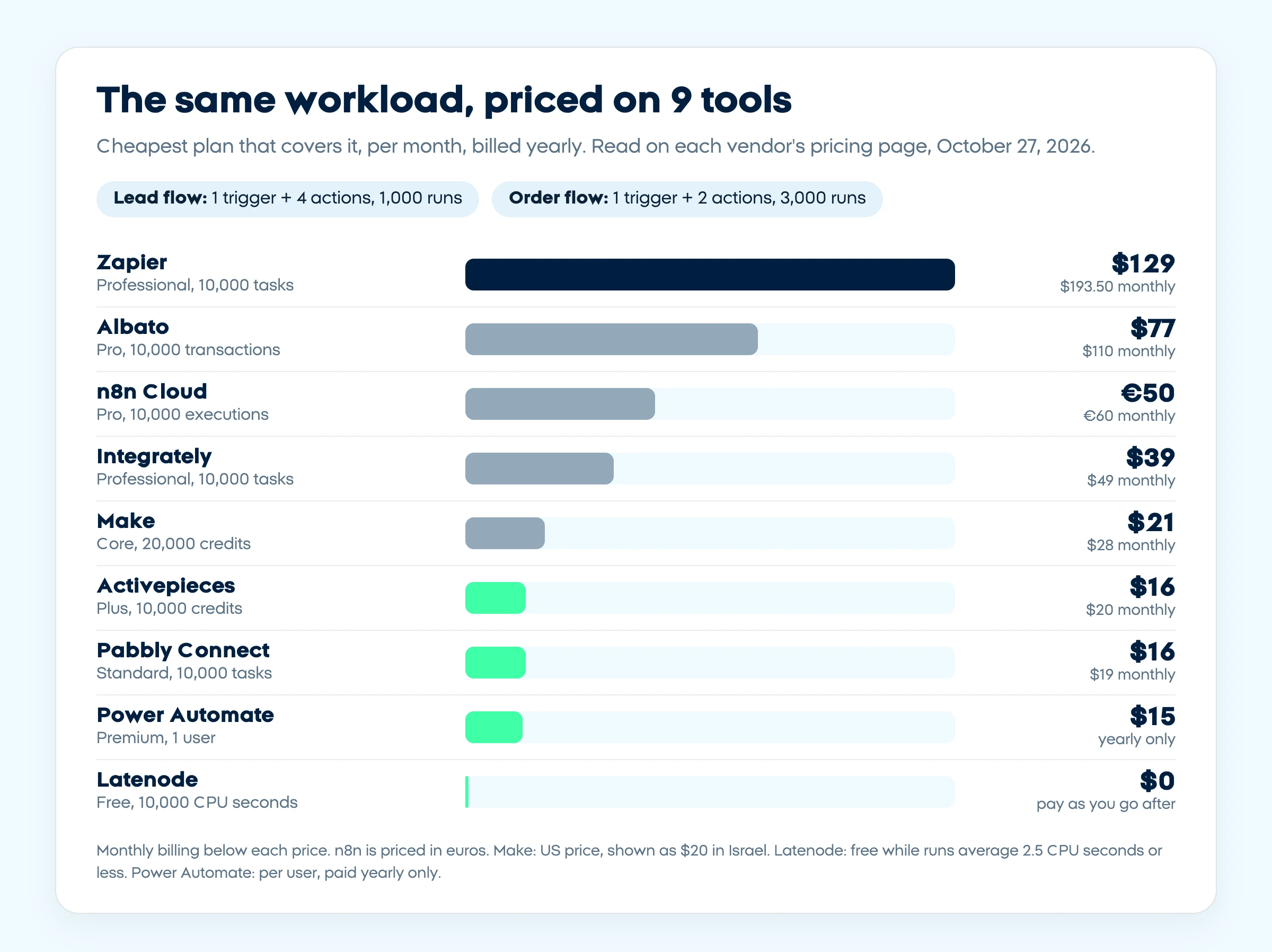
The best Zapier alternatives depend on why you're leaving. For the bill, pick a tool that counts whole runs (Activepieces, n8n) or charges less per step (Pabbly Connect, Make). To self-host, use n8n's Community Edition, Activepieces or Node-RED; for AI agents, Lindy or Gumloop; for Microsoft 365, Power Automate. On our test workload of 4,000 runs a month, the cheapest paid plans start at $16 a month against Zapier's $129, billed yearly.
Why people leave Zapier
People leave Zapier for five reasons: the bill as task volume grows, step and branching limits, no self-hosting, AI agent features and the size of the free plan. Two of them can be eased inside Zapier, so check those first.
- The bill grows with volume. Every successful action is a task, while triggers and built-in tools such as Filter, Paths, Formatter, Delay and Looping use none (how Zapier counts tasks). Professional starts at $19.99 a month billed yearly for 750 tasks and reaches $129 at 10,000 (Zapier pricing). Paying yearly saves 33%, and moving logic into free built-in steps cuts tasks.
- Steps and branching. Free runs two-step Zaps only; multi-step Zaps and webhooks start on Professional. Paths use no tasks once you're there.
- No self-hosting. Zapier's pricing page offers no version to install on your own server, so your data runs through Zapier's cloud.
- AI agents. AI by Zapier steps cost 1, 3 or 5 tasks by model tier (1 with your own model), and Zapier Agents run on a separate activity quota. Leave over AI only if you want a tool built around agents.
- The free plan. 100 tasks a month and two-step Zaps.
Pick a Zapier alternative by your reason for leaving
Start from the reason, not the tool. The last column is the monthly cost of our test workload (next section), billed yearly, on the cheapest plan that covers it.
| Why you're leaving | Try first, inside Zapier | Switch to | Our workload costs |
|---|---|---|---|
| The bill grows with tasks | Pay yearly (save 33%); move logic into free Filter, Paths and Formatter steps | Activepieces or n8n (per run), Pabbly Connect or Make (cheaper per step) | $16 Activepieces, $16 Pabbly, $21 Make (US), €50 n8n Cloud |
| You need multi-step or branching on a budget | Professional adds multi-step Zaps; Paths use no tasks | Make or Pabbly Connect (routers are free on both) | $21 Make (US), $16 Pabbly |
| You want to self-host or keep data on your servers | None | n8n Community Edition, Activepieces, Node-RED or Automatisch | $0 plus your server |
| You want AI agents more than workflows | AI by Zapier steps and Zapier Agents | Lindy or Gumloop; n8n, Make and Albato also have agent steps | Not priced: agent credits depend on the model and the work |
| You want a bigger free plan | Free: 100 tasks, two-step Zaps | Latenode or Activepieces | $0 on Latenode while runs average 2.5 CPU seconds or less |
| Your company runs on Microsoft 365 | None | Power Automate | $15 per user, paid yearly |
| You automate your own phone and smart home | Free plan | IFTTT | $2.99 (Pro, billed yearly), if every app has an IFTTT service |
USD a month unless marked; n8n in euros, as its page shows. Make prices by country: these are its US prices.
What the same workload costs on each tool: our calculation
We priced one realistic small-business workload on every tool with a public price. Zapier needs Professional at $129 a month billed yearly ($193.50 monthly); the same runs fit Activepieces Plus or Pabbly Connect Standard at $16, Make Core at $21 in the US and n8n Cloud Pro at €50.
The workload is two workflows with instant (webhook) triggers, no filters, AI or code steps, every run successful and one user:
Web form
A lead submits the form and a webhook starts the run
CRM
Create or update the contact
Google Sheets
Add a row to the leads sheet
Slack
Alert the sales channel
Gmail
Send the welcome email
Workflow 2 is a new store order (webhook trigger) that adds a Google Sheets row and posts in Slack: 1 trigger and 2 actions, 3,000 runs a month. Together that is 4,000 runs, 10,000 actions (4 x 1,000 + 2 x 3,000) and 14,000 module runs if the triggers count too (5 x 1,000 + 3 x 3,000).
| Tool | What it counts | Our workload | Cheapest plan that covers it | Billed yearly, per month | Monthly billing |
|---|---|---|---|---|---|
| Zapier | Tasks: each action | 10,000 tasks | Professional, 10,000 tasks | $129 | $193.50 |
| Albato | Transactions: each step after the trigger | 10,000 transactions | Pro, 10,000 transactions | $77 | $110 |
| n8n Cloud | Executions: one per run | 4,000 executions | Pro, 10,000 executions | €50 | €60 |
| Integrately | Tasks: each successful action | 10,000 tasks | Professional, 10,000 tasks | $39 | $49 |
| Make (US prices) | Credits: each module, trigger included | 14,000 credits | Core, 20,000 credits | $21 | $28 |
| Activepieces | Credits: one per run | 4,000 credits | Plus, 10,000 credits | $16 | $20 |
| Pabbly Connect | Tasks: action steps only | 10,000 tasks | Standard, 10,000 tasks | $16 | $19 |
| Power Automate | A license per user; requests capped per day | Under 500 requests a day | Premium, 1 user | $15 | Not offered |
| IFTTT | Applets; runs are unlimited | 2 multi-action Applets | Pro, 20 Applets | $2.99 | $4.99 |
| Latenode | CPU seconds: runs x average runtime | 4,000 to 40,000 CPU seconds | Free (10,000 CPU seconds), then pay as you go | Not offered | $0 to $3.60 |
All read on each vendor's pricing page on October 27, 2026. What the table hides:
- No room left. Zapier, Albato, Integrately and Pabbly Connect land exactly on their 10,000 tier, so one extra lead goes past it. Zapier then bills per task, up to 3 times the plan's limit, unless you turn that off (pay-per-task), and Albato bills extra transactions at 50% more.
- Make by country. Make's page shows prices by location; ours, in Israel, showed Core with 20,000 credits at $20 billed yearly. Buying extra credits on top of 10,000 costs 25% more per credit than plan credits (Make help).
- Latenode depends on runtime. At 1 or 2.5 seconds a run the workload fits the free 10,000 CPU seconds; at 5 seconds it costs $1.20 and at 10 seconds $3.60. We didn't measure real runtimes.
- Activepieces Free might be enough. Its plan table says the 1,000 free credits reset daily, which would cover about 133 runs a day; its FAQ says monthly.
- IFTTT only if your apps are there. The price holds only when every app in the workflow has an IFTTT service, which we didn't check app by app.
This clip proves the Zapier row on its own pricing page:
Screen recording of Zapier's pricing page on October 27, 2026: stepping the task slider from 100 to 10,000 tasks a month on yearly billing raises Professional from $19.99 to $129 a month and Team to $169, then switching to Pay monthly shows $193.50 and $253.50.
On month-to-month billing, with no yearly commitment, the same workload lines up like this:
Monthly list prices from each vendor's pricing page on October 27, 2026. Power Automate is left out because Microsoft shows only a paid-yearly price, and Latenode because its cost depends on runtime ($0 to $3.60 here).
The best Zapier alternatives in detail (checked October 27, 2026)
Each tool gets the same questions, ending with what happens to your Zaps. The order follows the decision table, not a ranking; for automation tools in general, see the best AI automation tools.
1. Make, for visual multi-step scenarios at a low price
- Price: Core costs $12 a month billed yearly or $16 monthly for 10,000 credits in the US, and $21 or $28 for 20,000 (Make pricing).
- Free plan: 1,000 credits a month.
- How usage counts: most module actions use 1 credit, reading from a webhook included; routers and error handlers use none. When credits run out, scenarios stop until you add more, and incoming webhooks wait in a queue.
- Hosting: Make's cloud; no self-hosted plan on its pricing page.
- AI: Make AI Agents and the AI Toolkit, with your own OpenAI or Anthropic connection on every paid plan.
- From your Zaps: no importer. A Zap with a trigger and 4 actions uses 4 Zapier tasks but 5 Make credits per run; n8n vs Zapier vs Make prices other workflows on those three.
2. n8n, for long workflows billed per run, in the cloud or on your server
- Price: Cloud Starter is €20 a month billed yearly or €24 monthly for 2,500 executions; Pro is €50 or €60 for 10,000 (n8n pricing). Every plan lists unlimited steps.
- Free plan: a free trial on Cloud; the self-hosted Community Edition is free, and you pay only for the server.
- How usage counts: one execution per workflow run, "regardless of complexity", so a 20-step run costs the same as a 2-step one.
- Hosting: Cloud or self-hosted, under n8n's Sustainable Use License, which n8n calls fair-code rather than open source.
- AI: Agents, MCP and AI nodes from Starter up, plus AI models you can use without your own API keys.
- From your Zaps: no official importer, so you rebuild; the n8n pricing guide covers execution rules and server costs, and n8n alternatives covers the trade-offs if n8n turns out not to fit.
3. Activepieces, one credit per run and an MIT core
- Price: Plus is $16 a month billed yearly or $20 monthly for 10,000 credits and up to 5 users, then $0.007 per extra credit; Team is $166 or $200 for 50,000 credits and 25 users (Activepieces pricing).
- Free plan: 1,000 credits, unlimited flows and up to 5 users.
- How usage counts: "A run is one credit however many steps it has"; AI steps add 2, 10 or 20 credits by model, or 1 with your own keys on Plus and up.
- Hosting: Cloud or on your own servers on every plan. The code is MIT, except the enterprise folders, which have their own license.
- AI: Agents, Chat, Tables and MCP access, plus building flows from a chat.
- From your Zaps: Activepieces' own blog says there's no import path to count on, so plan to rebuild each workflow by hand.
4. Pabbly Connect, for low prices on action-only tasks
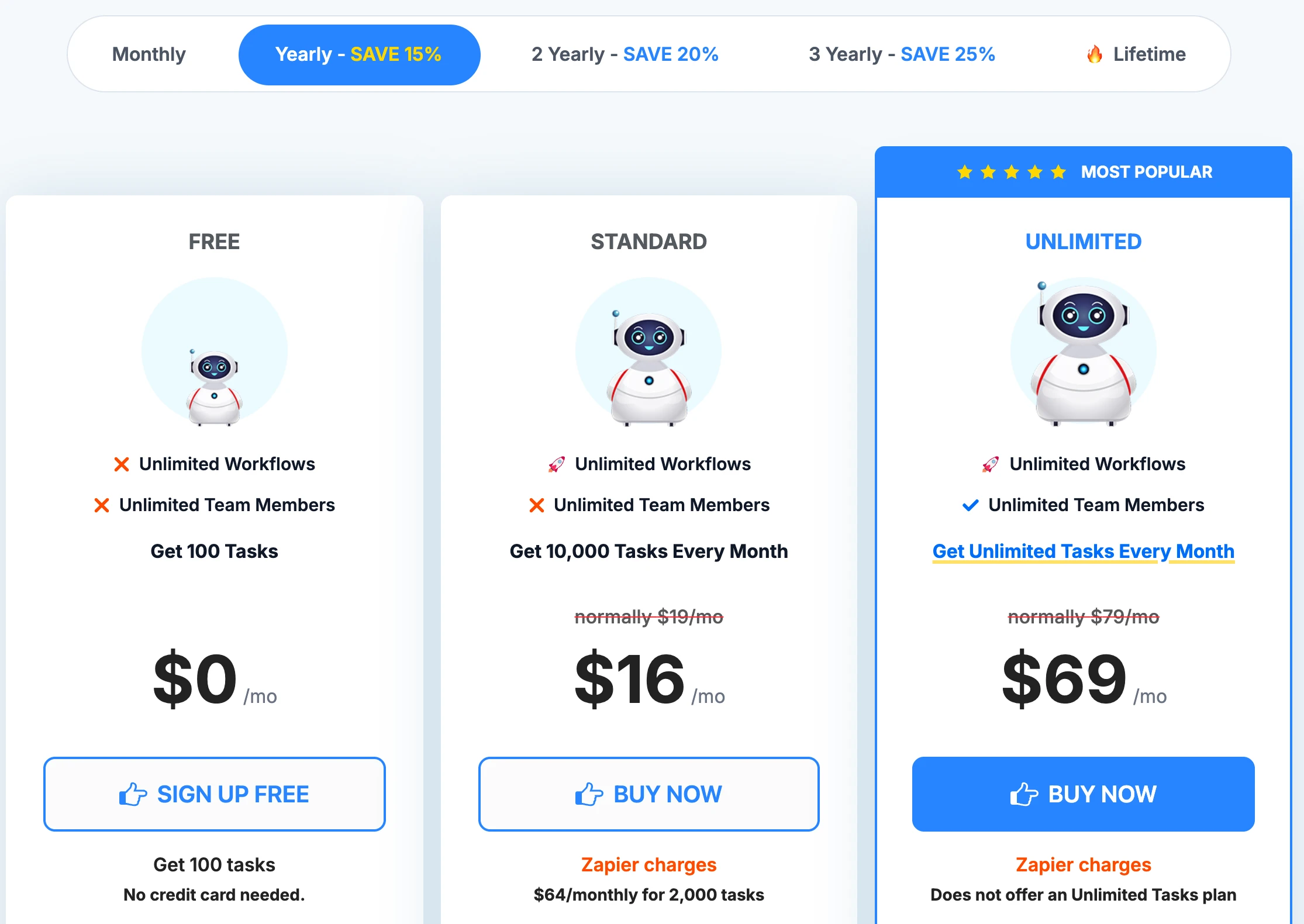
- Price: Standard is $19 a month, or $16 a month billed yearly, for 10,000 tasks ($15 on 2-year and $14 on 3-year billing); Unlimited is $79 monthly or $69 yearly (Pabbly Connect pricing).
- Free plan: 100 tasks and 2-step workflows.
- How usage counts: only action steps use tasks; triggers and internal steps such as Filter, Router and Formatter are free.
- Hosting: Pabbly's cloud. Pabbly says it holds SOC 2 Type 2 and ISO 27001:2022.
- AI: an AI Assistant, MCP servers and JavaScript or Python code steps.
- From your Zaps: no importer found. The task math is Zapier's, so your Zap history tells you the tier you need.
5. Integrately, for ready-made app-to-app automations
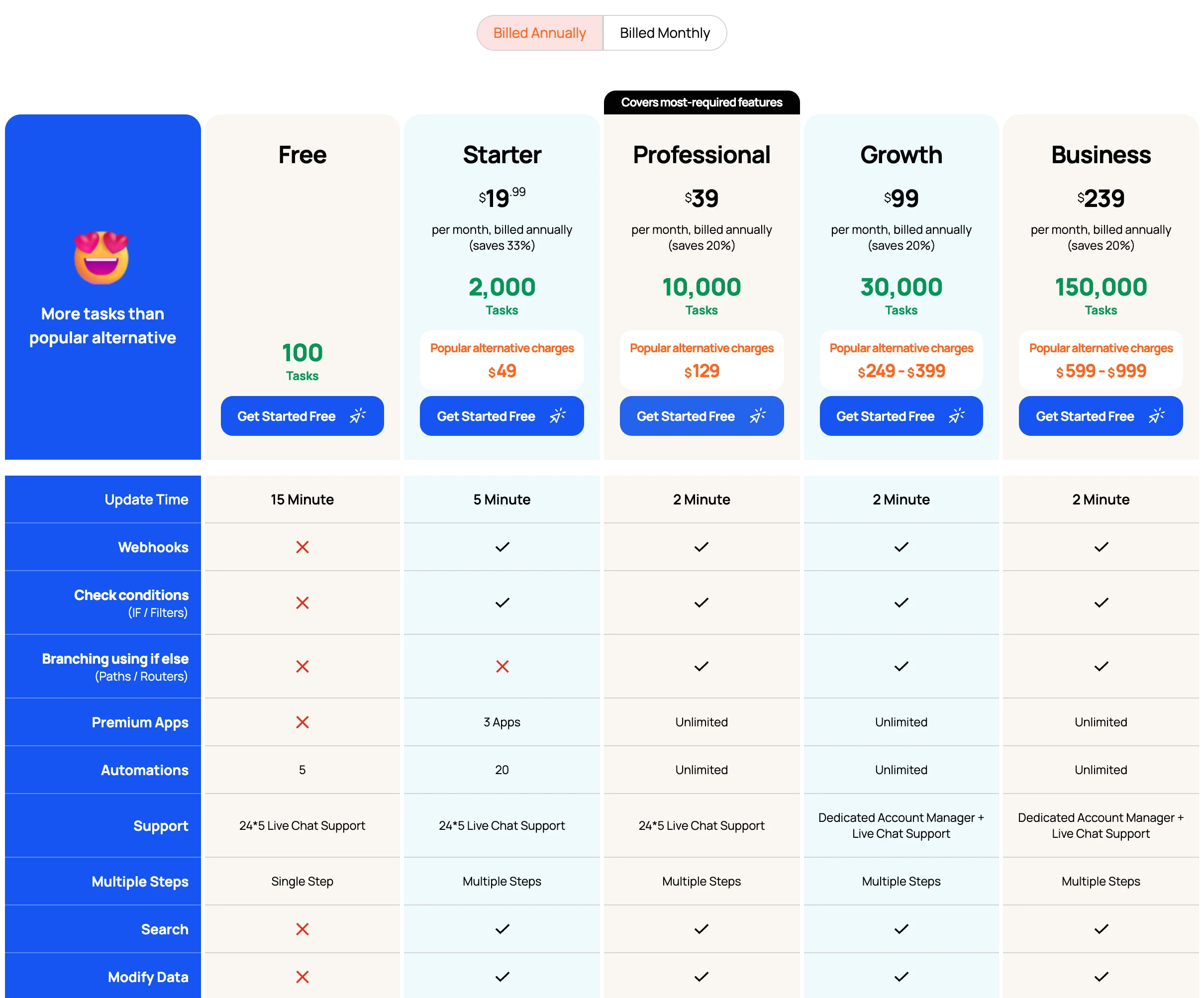
- Price: Professional is $39 a month billed yearly or $49 monthly for 10,000 tasks; Starter is $19.99 or $29.99 for 2,000 tasks, taxes extra (Integrately pricing).
- Free plan: 100 tasks, single-step automations, 15-minute updates and no webhooks.
- How usage counts: every successful action is a task, and a data edit or search inside an action counts as its own task; triggers and checks are free.
- Hosting: Integrately's cloud.
- AI: its pricing page lists no AI or agent features.
- From your Zaps: no importer found. Branching (if/else paths) starts on Professional, so a Zap with Paths needs that tier.
6. Albato, transactions with AI agents on the Pro plan
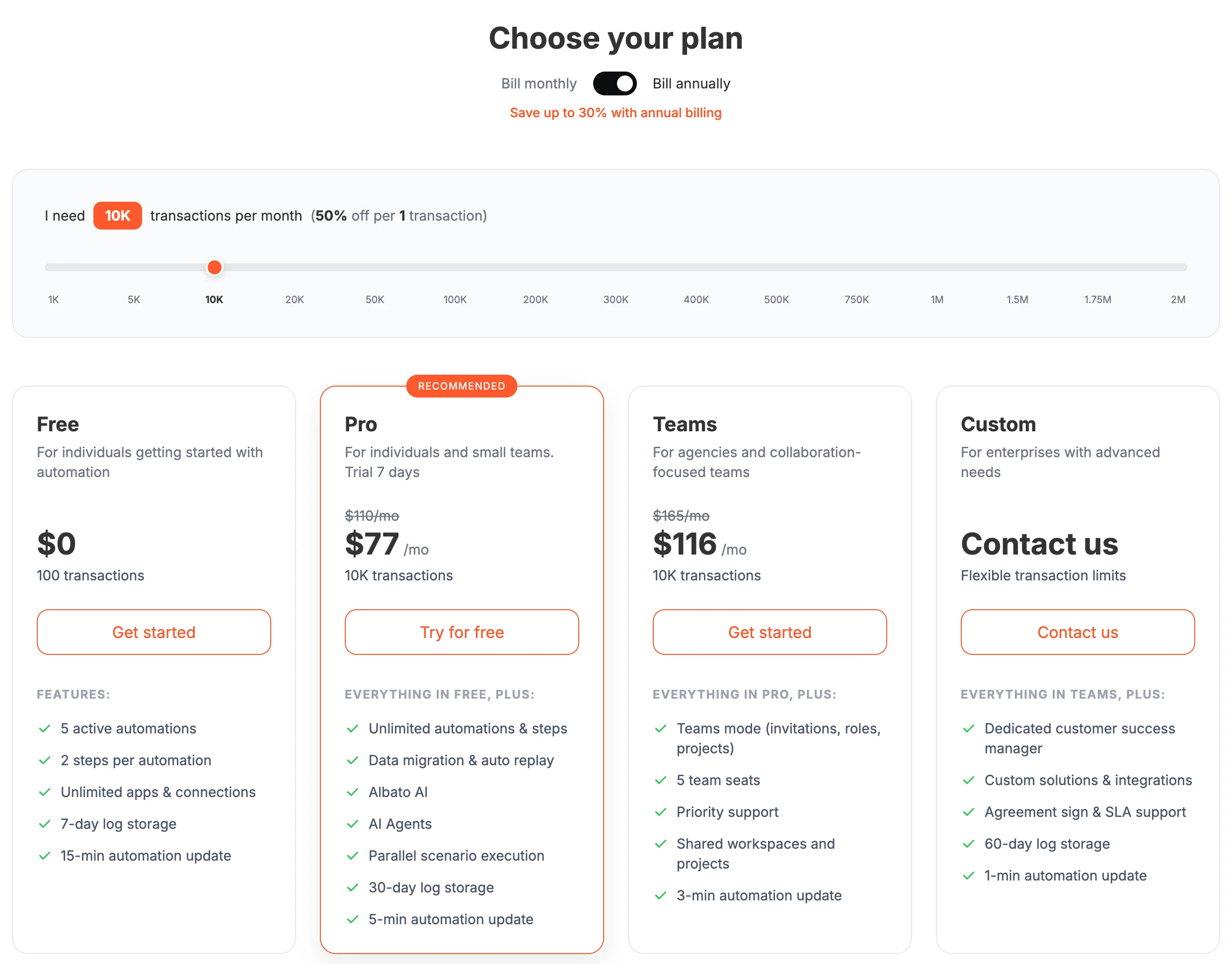
- Price: Pro is $77 a month billed yearly or $110 monthly at 10,000 transactions, and $15 or $22 at 1,000 (Albato pricing). You choose the plan and the transaction package separately.
- Free plan: 100 transactions, 5 active automations and 2 steps per automation.
- How usage counts: "A transaction is counted for each automation step that runs after the trigger." Past your package, transactions cost 50% more.
- Hosting: Albato's cloud; it also sells an embedded version for software companies.
- AI: Albato AI and AI Agents on Pro.
- From your Zaps: no importer found. Albato's "data migration" feature moves records between apps, not Zaps.
7. Latenode, if you'd rather pay for runtime than for steps
- Price: no base fee. The first 10,000 CPU seconds a month are free, then $0.00012 per CPU second up to 100,000 (Latenode pricing).
- Free plan: 10,000 CPU seconds, 5 active scenarios, 1 worker and runs of up to 3 minutes.
- How usage counts: runs x average CPU seconds per run; extra nodes don't add to the bill unless they add processing time.
- Hosting: Latenode's cloud.
- AI: an AI Agent node and paid AI or data nodes billed in Plug-n-Play tokens at $1 each, on top of runtime.
- From your Zaps: no importer found; its page offers a calculator to compare a Zapier or Make bill.
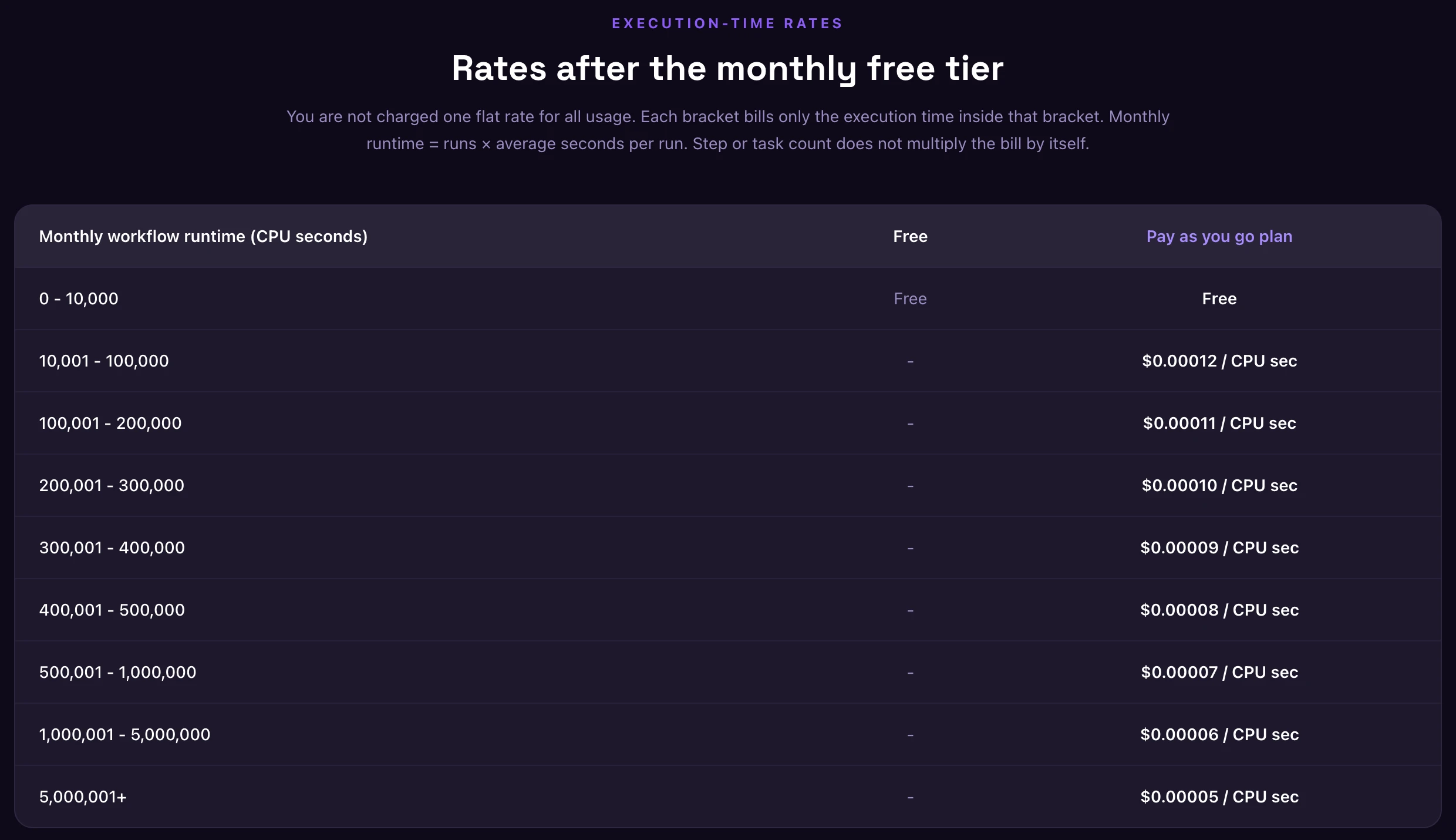
8. Microsoft Power Automate, if your company runs on Microsoft 365
- Price: Premium is $15.00 per user a month, paid yearly; Process is $150.00 per bot and Hosted Process $215.00 (Power Automate pricing).
- Free plan: a 30-day trial with standard connectors only.
- How usage counts: a license per user, with 40,000 requests per 24 hours per paid license and 6,000 for Microsoft 365 licenses; every connector call and action counts, successful or failed (request limits).
- Hosting: Microsoft's cloud, plus desktop flows (RPA) that automate apps on a computer.
- AI: Copilot in Power Automate; agent flows are metered through Copilot Studio instead of requests.
- From your Zaps: no importer. Premium includes standard, premium and custom connectors, while the free trial has standard connectors only.
9. IFTTT, for personal and smart home automations
- Price: Pro is $2.99 a month billed yearly ($35.88) or $4.99 monthly for 20 Applets; Pro+ is $8.99 or $14.99 for unlimited Applets (IFTTT plans).
- Free plan: 2 Applets with unlimited runs.
- How usage counts: by the number of Applets, not runs. Multi-action Applets and webhooks need Pro; filters and AI services need Pro+.
- Hosting: IFTTT's cloud.
- AI: AI services on Pro+.
- From your Zaps: no importer. Check that every app in a Zap has an IFTTT service before you plan a move.
10. Node-RED, free on your own machine
- Price: free; Node-RED is Apache 2.0 software with no paid plan of its own (nodered.org).
- How usage counts: it doesn't; you pay for the computer it runs on.
- Hosting: your laptop, a Raspberry Pi, Docker or a cloud server, with FlowFuse, AWS and Azure listed as cloud options.
- AI: add it through the community's 5,000+ nodes and flows, or call a model's API from a flow.
- From your Zaps: no importer, and Node-RED's editor isn't secured by default, so anyone who can reach its address can change your flows until you set up a login.
11. Automatisch, built as an open source Zapier alternative
- Price: free to self-host. Its site mentions a cloud option, but its pricing page returned "404" on October 27, 2026 (automatisch.io).
- How usage counts: no metering when you host it.
- Hosting: your own servers; the Community Edition is AGPL-3.0, and files marked ".ee." are under an enterprise license.
- AI: none listed on its site.
- The catch: its last GitHub release, v0.15.0, came out on August 8, 2025, so check recent activity before you depend on it.
12. Lindy, for an AI assistant that works in Slack and email
- Price: Team is $29.99 a month per active user with 3,000 credits each, plus $10 per extra 1,000 credits (Lindy pricing).
- Free plan: $50 in credits for 7 days, no card needed.
- How usage counts: credits per job: 2 to 250 for an everyday ask and up to 2,500 for a big build. When the team pool runs low, Lindy pauses and tells you.
- AI: the whole product, with model choice per task, 1,500+ integrations and MCP support.
- From your Zaps: no importer; you describe each job to the agent instead.
13. Gumloop, for AI agents across your tools
- Price: Pro starts at $37 a month with 20,000 credits and a 14-day free trial (Gumloop pricing).
- How usage counts: credits, plus an 8% orchestration fee on Pro.
- AI: unlimited agents and 35+ models.
- From your Zaps: no importer, and Gumloop now labels its workflow builder "Workflows (Legacy)", so expect to turn a Zap into an agent's instructions.
Free and open source Zapier alternatives, and their catch
Free Zapier alternatives come in two kinds: hosted free plans with a usage cap, and open source tools you run yourself. Each has a catch.
| Option | What's free | The catch |
|---|---|---|
| Latenode Free | 10,000 CPU seconds a month, no node limit | 5 active scenarios, 1 worker, runs up to 3 minutes |
| Activepieces Free | 1,000 credits, unlimited flows, 5 users | Daily or monthly reset: its page says both |
| Make Free | 1,000 credits a month | Credits per module, so about 200 runs of a 5-module scenario |
| n8n Community Edition | Self-hosted, no execution cap from a plan | Fair-code license, not open source; the server is yours |
| Activepieces Community Edition | Self-hosted, MIT outside enterprise folders | Access control, Agents and Chat need a paid plan |
| Node-RED | Everything, Apache 2.0 | Editor not secured by default; built for technical users |
| Automatisch | Self-hosted, AGPL-3.0 | Last release in August 2025 |
| Zapier, Pabbly Connect, Albato Free | 100 tasks or transactions | Two steps per workflow |
For open source Zapier alternatives that a non-coder can run, Activepieces is the realistic pick: try its hosted free plan first, then self-host the same flows if you need to.
What carries over when you leave Zapier
Your Zaps come out as a file, but no alternative here can run that file, and your app connections and webhook addresses don't move at all.
| Piece of your Zapier setup | Carries over? | What to do |
|---|---|---|
| Zap workflows | Partial | Download them as JSON under Settings, Security and data, "Download my Zap workflows", on every plan (export help); use the file as the spec for the rebuild |
| Zap history | Partial | Export up to 5,000 runs at a time as CSV or JSON (history export) and count your real runs per Zap |
| App connections | No | Reconnect each app in the new tool and revoke Zapier's access after the switch |
| Webhook URLs | No | Every form, store or app that sends to a hooks.zapier.com address keeps sending there until you change it |
| Filters and Paths | Partial | Rebuild them as the new tool's filters or routers; on Integrately, branching needs Professional |
Zapier's history export tells you each Zap's real volume. An AI assistant can turn it into usage for the tool you're weighing; check its counting rule against the vendor's page before you trust the result:
Here is a list of my Zaps with the number of steps (trigger plus actions) and the runs each had last month: [PASTE ZAP NAME, STEPS AND RUNS].
I am comparing Zapier with [ALTERNATIVE]. Its pricing page says it counts usage like this: [PASTE THE COUNTING RULE FROM ITS PAGE].
For each Zap, work out Zapier tasks (actions only) and [ALTERNATIVE] units, show the arithmetic, then total both and tell me which of these tiers covers the total with 20% room: [PASTE ITS TIERS AND PRICES].
Stay on Zapier if
Switching costs rebuild time, so Zapier stays the better choice in a few cases:
- An app you depend on is only on Zapier. Zapier lists 9,000+ apps; check every app in your Zaps on the new tool first.
- Your volume is small. At 750 tasks Professional costs $19.99 a month billed yearly; saving a few dollars rarely pays for a weekend of rebuilding.
- You use Tables, Forms or Zapier MCP. They come with every Zapier plan, and you'd have to replace each one separately.
- Your team already knows Zapier. Retraining people on a new editor is a cost the price table doesn't show.
Where our AI automation course fits
ai school teaches AI automation and I build automations for clients, so read this page with that in mind: that's why nothing here is ranked and our course isn't in the tables. The AI automation course is in early access (pre-order) and teaches automation with Claude Code and the tools we use with clients; the exact list is announced before launch. If a tool above fits your reason better, use that tool.
Quick check0 of 2 correct
A Zap with a trigger and 4 actions runs 1,000 times a month. How many Zapier tasks does it use?
Not quite.
Zapier counts each successful action as a task and never the trigger, so 4 actions x 1,000 runs is 4,000 tasks. n8n and Activepieces would count 1,000.
You move a form workflow from Zapier to Make. What happens to the webhook URL your form sends to?
Not quite.
Webhook URLs belong to the tool that created them, and no tool here imports Zaps, so every sender has to be pointed at the new address.
What to do next
Export your Zap history, count last month's runs and steps per Zap, and price them on the two tools that fit your reason, using the table above as the template. Rebuild your busiest Zap on the new tool's free plan or trial and run both side by side for a week before you cancel anything. If n8n is on your list, the n8n tutorial for beginners builds a first workflow step by step, the kind of build our AI automation course starts from.
Zapier switch checklist: audit, export, rebuild, run in parallel
A one-week plan for leaving Zapier safely: audit every Zap and its real task use, export what Zapier lets you export, rebuild in the right order and run both tools side by side before you cancel.
Enter your email and the full section opens right here. You also get a free lesson from the course.
Frequently asked questions
What is the cheapest Zapier alternative?
For our test workload of 4,000 runs a month (10,000 Zapier tasks), Latenode's free plan covers it while runs average 2.5 CPU seconds or less, and the cheapest paid plans are Activepieces Plus and Pabbly Connect Standard at $16 a month billed yearly. Zapier Professional costs $129 for the same runs.
Is there a free Zapier alternative for multi-step workflows?
Yes. Latenode's free plan gives 10,000 CPU seconds a month with no limit on nodes per scenario, and Activepieces Free gives 1,000 credits with unlimited flows. Self-hosted n8n, Node-RED and Automatisch cost only the server. Zapier's, Pabbly's and Albato's free plans stop at two steps, Integrately's at one.
Can I import my Zaps into Make, n8n or another tool?
Not with a vendor tool we could find on October 27, 2026. Zapier lets you download your Zap workflows as a JSON file on every plan, but none of the alternatives here documents an importer for it, and Activepieces says plainly to rebuild each workflow by hand.
What is the best open source Zapier alternative?
Activepieces is the closest for non-coders: its code is MIT outside its enterprise folders and it bills one credit per run. Automatisch (AGPL-3.0) was built as an open source Zapier alternative but had its last release in August 2025, Node-RED (Apache 2.0) suits technical users, and n8n is fair-code rather than open source.
Why does the same workflow cost so much more on Zapier?
Because each tool counts something different. Zapier bills every successful action as a task, so a trigger plus 4 actions is 4 tasks per run, while n8n and Activepieces bill the whole run once and Latenode bills processing time. The more steps a workflow has, the wider the gap.
Keep reading
n8n Alternatives (2026): What to Switch To and Why
n8n alternatives by reason for leaving: server, bill, license or learning curve. 10 tools with prices checked October 2026, plus what carries over from n8n.
Automation and agents · 18 min readn8n vs Zapier vs Make 2026: Real Costs for the Same Workflow
n8n vs Zapier vs Make: the same 8,000 orders a month cost $489 on Zapier, $72 on Make, $50 on n8n, billed yearly. We also compare free plans and AI agents.
Automation and agents · 11 min readBest AI Automation Tools in 2026: 10 Picks With Real Prices
The best AI automation tools for 2026: Zapier, Make, n8n, Claude Code and 6 more, with verified prices, free and open-source options and a pick-by-need table.
Automation and agents · 15 min read