Prompt Engineering Course (2026): Best Free and Paid Picks
Every course below was checked on its own page on October 25, 2026. We also ran one real task three ways to see which skills a course has to teach you.
By Yotam DahanUpdated 16 min readChoosing an AI course
The best prompt engineering course for most people who don't code is free: OpenAI Academy's AI Foundations takes about 70 minutes and has you practice on a real task of your own, and Google Prompting Essentials adds a Google certificate for $49 a month on Coursera. Pay for a course only if it makes you practice on your own work and teaches you to give the AI your facts, files and examples, not just better wording. In our test, a well-written prompt got Claude to 6 of 12 checks on three customer emails; the same one-line request with four small files of business context scored 12 of 12.
Best prompt engineering courses compared
These are the prompt engineering courses a non-coder is most likely to find, with what each page says today.
| Course | Price | Length | Certificate | Last updated |
|---|---|---|---|---|
| OpenAI Academy, AI Foundations | Free with a ChatGPT account | About 70 minutes | Badge for 80% on the assessment | Launched June 2026 |
| Google Prompting Essentials on Coursera | $49 a month (US and Canada) after a 7-day free trial | Under 10 hours, 4 courses | Google certificate | No date shown |
| Vanderbilt, Prompt Engineering for ChatGPT on Coursera | Free to enroll; the certificate is paid | 2 weeks at 10 hours a week | Vanderbilt certificate | No date shown; launched May 2023 |
| IBM, Generative AI: Prompt Engineering Basics on Coursera | Free to enroll; the certificate is paid | About 9 hours | IBM certificate | Description refreshed in 2026 |
| DeepLearning.AI, AI Prompting for Everyone | Videos free; certificate with Pro, $25 a month billed yearly | 7 hours, 21 videos | DeepLearning.AI certificate | Updated July 24, 2026 |
| LinkedIn Learning, Prompt Engineering: How to Talk to the AIs | Subscription, 1-month free trial | 54 minutes | Certificate of completion | Released August 11, 2026 |
| DataCamp, Understanding Prompt Engineering | First chapter free; Premium from $14 a month billed yearly | 1 hour, 29 exercises | Statement of Accomplishment | Published August 28, 2026 |
| Learn Prompting, Introduction to Prompt Engineering | Plus plan, $21 a month billed yearly, 3-day free trial | 10 modules, self-paced | Learn Prompting certificate | No date shown |
| Maven, Stop Prompting. Start Building Systems. | $950 beta price; current cohort sold out | 4 live sessions | Maven certificate of completion | Cohort running October 20 to November 10, 2026 |
The test further down shows the two things a course has to teach: practice on your own work, and giving the AI context (files, examples, background), not only wording. Here is what each course page promises on both:
| Course | Practice on your own work | Teaches context |
|---|---|---|
| OpenAI Academy, AI Foundations | Yes | Yes |
| Google Prompting Essentials | Partial | Yes |
| Vanderbilt, Prompt Engineering for ChatGPT | No | Partial |
| IBM, Generative AI: Prompt Engineering Basics | No | Partial |
| DeepLearning.AI, AI Prompting for Everyone | Partial | Yes |
| LinkedIn Learning, Prompt Engineering: How to Talk to the AIs | No | Yes |
| DataCamp, Understanding Prompt Engineering | No | Partial |
| Learn Prompting, Introduction to Prompt Engineering | Partial | Not stated |
| Maven, Stop Prompting. Start Building Systems. | Yes | Yes |
Only two of these say plainly that you work on your own material: OpenAI Academy, whose hub says people learn "by practicing on work that matters to them", and the Maven live cohort. Udemy's prompt engineering courses block automated checks, so we couldn't verify their prices or update dates; if you buy there, watch the free preview and read the "last updated" month first.
Free prompt engineering courses worth your time
OpenAI Academy's AI Foundations is the best free prompt engineering course to start with. You pick a task you do every week and practice "giving clear instructions, providing context, reviewing outputs" on it, then pass an assessment with 80% or more for a badge; 58,163 people had joined it on October 25, 2026. Our best ChatGPT courses guide covers the two Academy courses that follow it.
The best-known Coursera prompt engineering course is still Vanderbilt's Prompt Engineering for ChatGPT, with 748,879 learners and 4.8 stars from 8,231 reviews. You can enroll for free, but the certificate needs a paid option, and its lessons date from 2023: it opens with an "Act as a Speech Pathologist" example and drills persona patterns that today's models need less. IBM's Prompt Engineering Basics (about 9 hours, 694,008 learners) works the same way: free to watch, paid certificate.
If you want a free prompt engineering course with a certificate, there are three, each with a catch:
- Cognitive Class, Prompt Engineering for Everyone: IBM's free skills site, 5 hours with 9 labs and a certificate, but its labs use 2023-era persona exercises.
- Simplilearn SkillUp: listed as one hour of video and a free completion certificate, with 90 days of access after you register.
- Microsoft Learn: free Copilot modules with a badge. Microsoft has retired its standalone Copilot prompting course, so prompting is now a 4-minute unit inside its Copilot path.
LinkedIn Learning is also free through US public libraries that offer it: its help center says patrons sign in with a library card, though their names can't appear on the certificates.
Paid prompt engineering courses: what the money buys
Google Prompting Essentials
A Google prompt engineering course with Google's name on the certificate, 403,786 learners and 4.8 stars. Built around everyday work tasks in Gemini, with a reusable prompt library.
DeepLearning.AI
The newest AI prompt engineering course for non-coders we found, taught by Andrew Ng: ChatGPT, Claude and Gemini, with lessons on context, deep research and desktop apps.
LinkedIn Learning 2026
A 54-minute re-recording of its most popular course, now about context engineering, agents and memory. Worth it if you already pay for LinkedIn Learning.
Live cohort
Maven's four live sessions are the only live course we found built around your own projects, at $950. Pay this much only if feedback from a person matters to you.
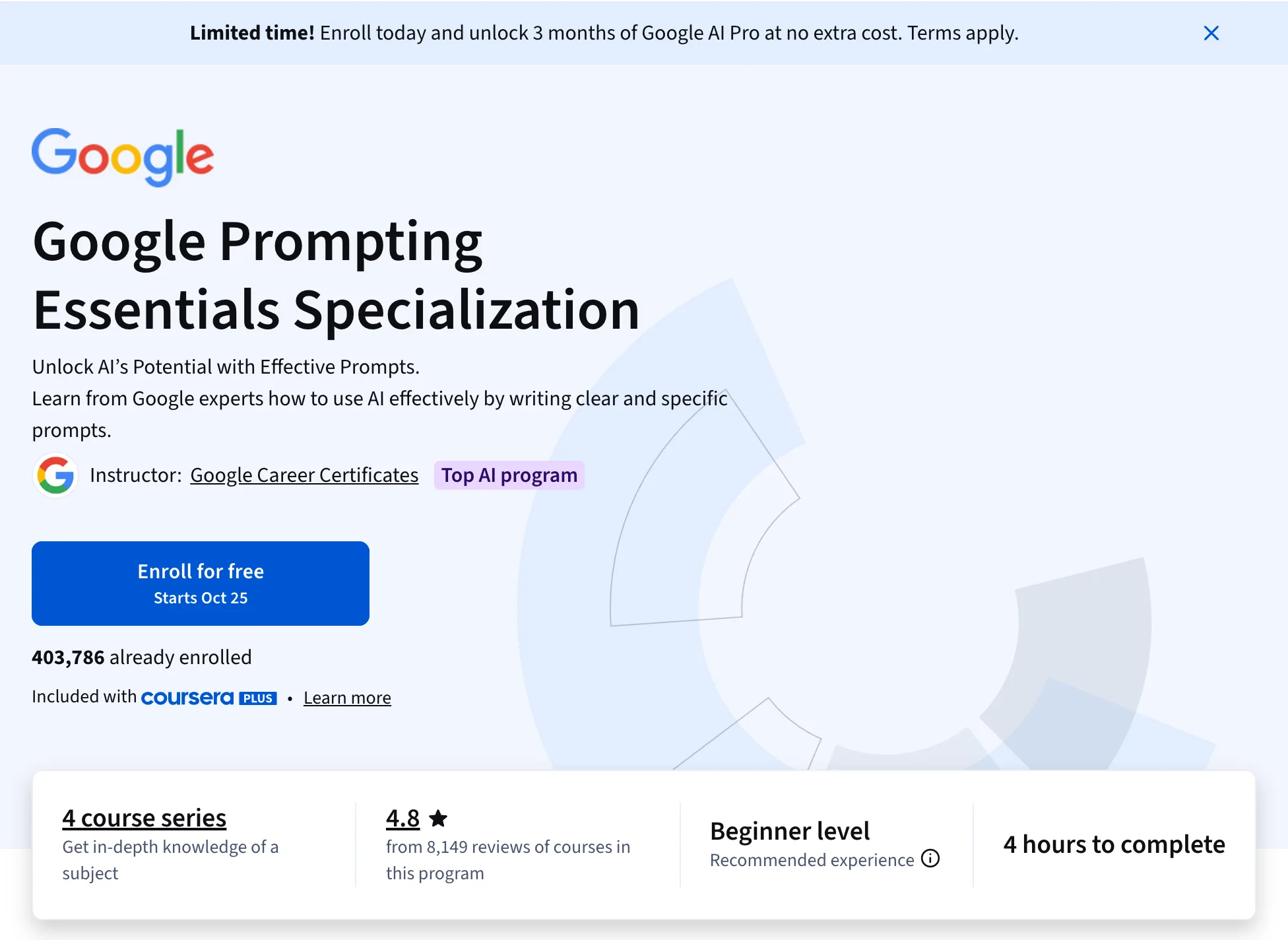
Prompting Essentials is a separate program from Google AI Essentials, which covers AI more broadly; our Google AI Essentials review compares the two. Two famous names are courses for developers rather than everyday users: DeepLearning.AI's ChatGPT Prompt Engineering for Developers uses Python and the OpenAI API, and AWS Skill Builder's free Foundations of Prompt Engineering is built on Amazon Bedrock for developers and data scientists.
Prompt engineering certification: what you can actually earn
No AI company sells a prompt engineering certification to the public. OpenAI's only certification, OpenAI Certified, runs inside ChatGPT and is open only to ChatGPT Enterprise and Edu workspaces by invitation (OpenAI's help page). Anthropic's Claude Certification Program has four proctored exams, and its registration page says certification "is open to organizations in the Claude Partner Network" (Pearson VUE's Anthropic page).
The closest thing to an exam that anyone can take is Microsoft's AI Business Professional certification, exam AB-730: a 45-minute proctored exam for business users, no coding required, that tests prompting and chats in Microsoft 365 Copilot (Microsoft Learn). It is a real certification, but only for Copilot. Everything else is a certificate of completion:
Course certificates
Coursera, LinkedIn Learning, DataCamp and Codecademy certify that you finished a course, in their name or in the name of Google, IBM or Vanderbilt. None is an exam.
Free badges
OpenAI Academy gives a badge per course for 80% on its assessment, and OpenAI says plainly that its badges are not certifications.
"Certified prompt engineer" titles
Sold by training companies. Learn Prompting lists a Certified Prompt Engineering Professional with no price or exam format on its page. Ask who issues it and how it is tested.
Your own proof
A before-and-after of one real task, with the prompt and the files you gave the AI. A client or an employer can judge it on the spot.
What a prompt engineering course should teach: we tested it
Most prompt engineering courses teach you to word a request well. We wanted to know how far that gets you on real work, so we gave Claude one ordinary job three ways: draft replies to three customer emails for Fernwood Flowers, a two-person florist we made up.
The emails were chosen so that a prompt alone can't get them right. A couple asks what wedding flowers cost (the items add up to $780, under the shop's $1,200 wedding minimum). Dan's morning delivery arrived at 6:40 pm (policy: refund the $15 delivery fee and the $10 morning slot, plus a 20% store credit). Lena wants a same-day bouquet at 2:30 pm (the cutoff is 1 pm). We scored every reply on 12 checks: for each email, the figures, the policy, the voice (signed "Mara at Fernwood Flowers", no exclamation marks) and a 120-word limit.
CLAUDE.md
11 lines of standing instructions: who Mara is, the voice rules, and "use only the price list and policies, mark anything missing".
price-list.csv
9 items: three bouquet sizes, wedding pieces, two delivery zones and the morning slot.
policies.md
14 lines on same-day delivery, late deliveries and weddings.
examples/
Three past replies in Mara's voice.
Version 1: a vague prompt, no context
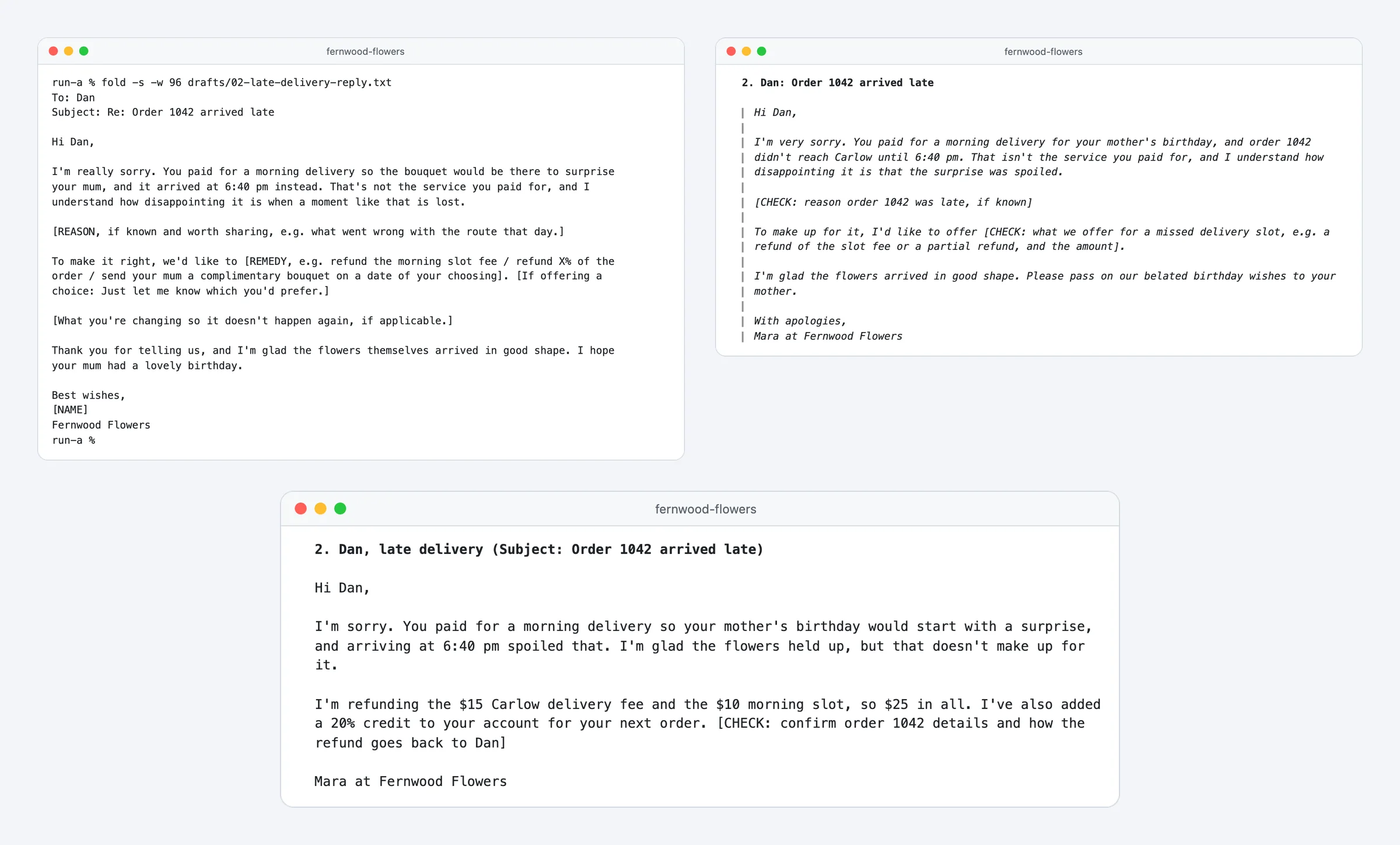
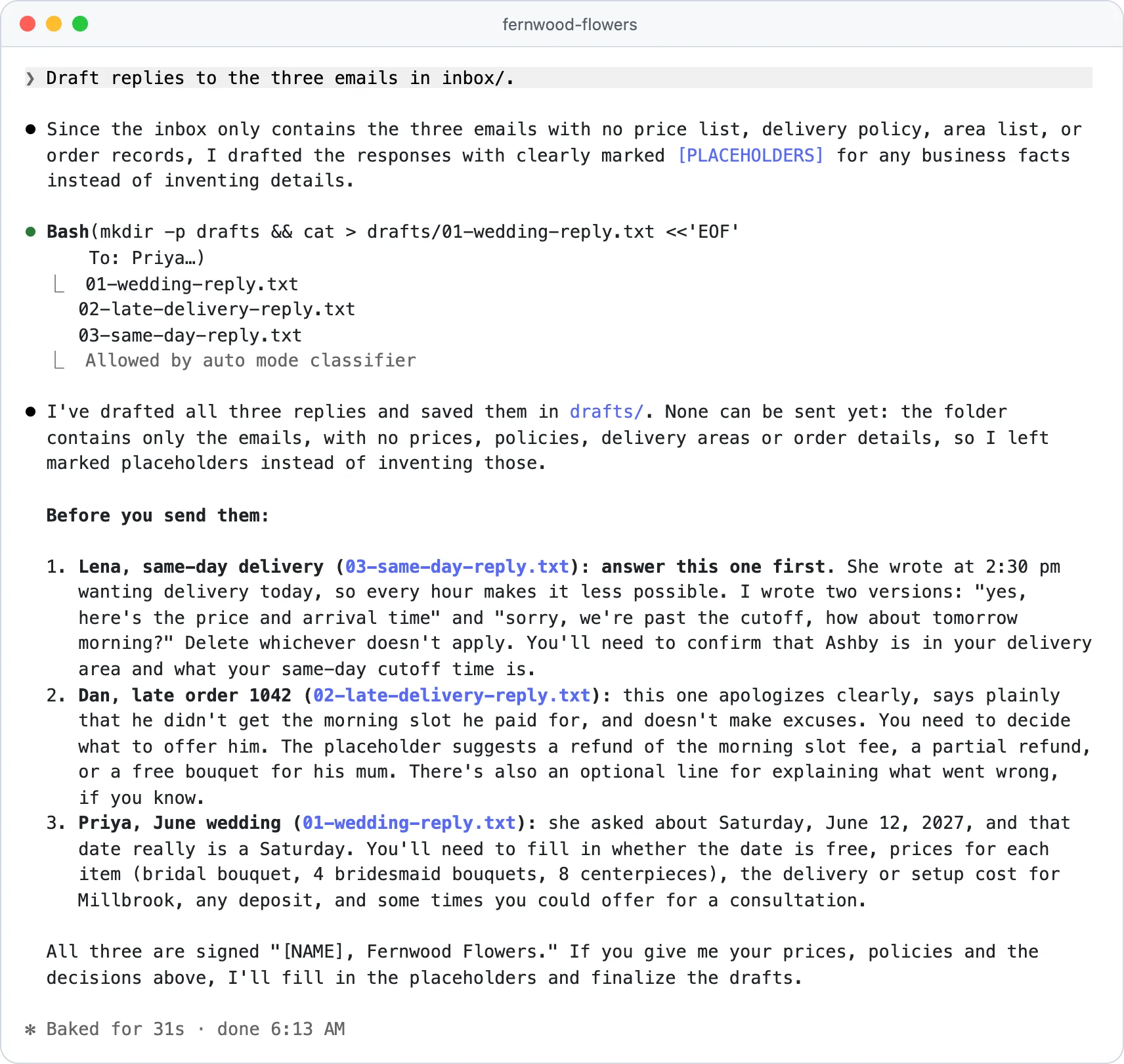
We typed Draft replies to the three emails in inbox/. in a folder that held only the three emails. Claude did not make anything up. It said the folder had no price list or policies, saved three drafts with 23 blanks such as [REMEDY] and [PRICE RANGE], signed them [NAME], and wrote 123 to 167 words each. Useful as a starting point, but none of the 12 checks passed.
Version 2: the kind of prompt a course teaches
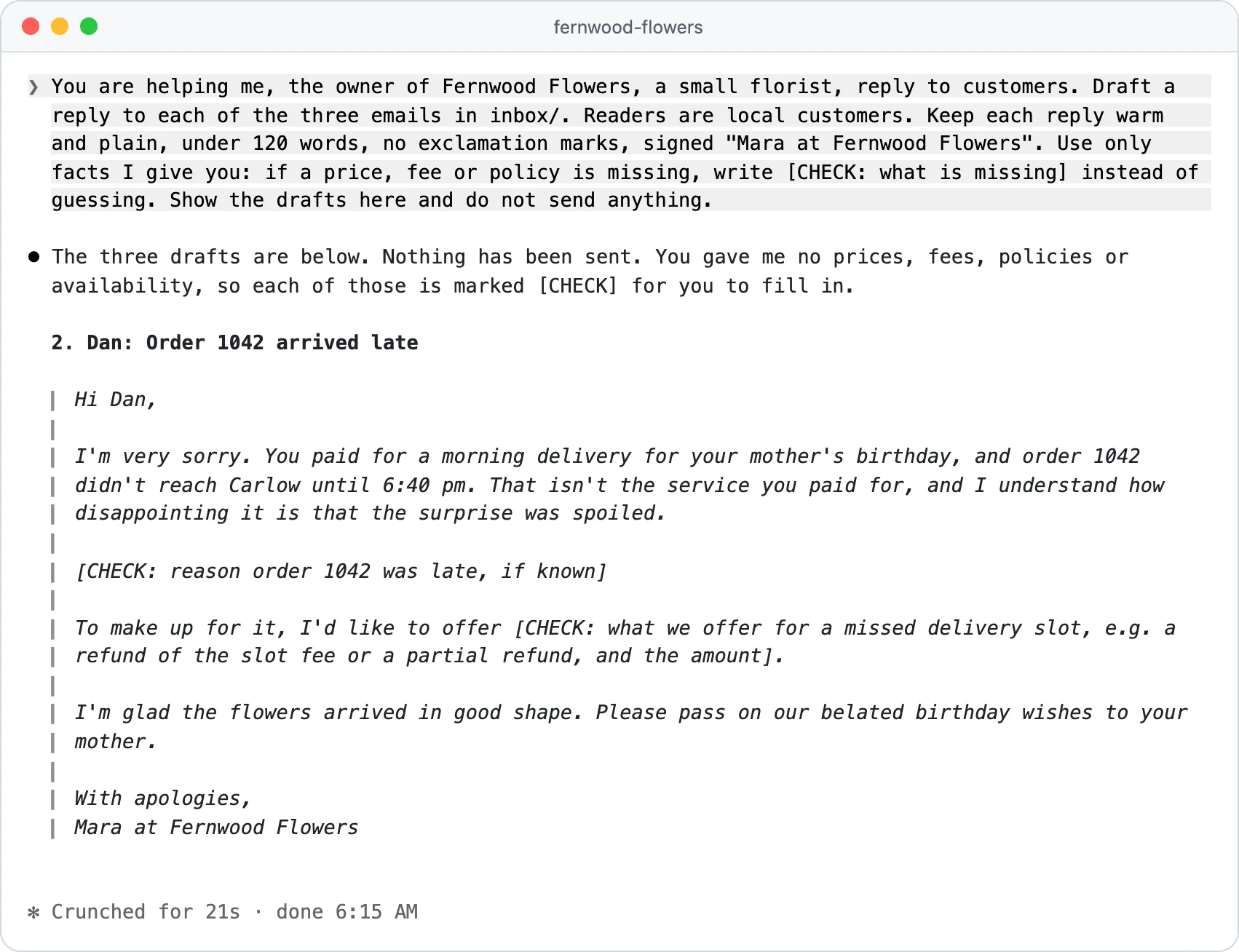
Next, a fresh folder and the prompt a good course would have you write: who you are, who reads the reply, the tone, a length limit, the sign-off, and an instruction to mark missing facts instead of guessing.
You are helping me, the owner of [BUSINESS], reply to customers. Draft a reply to each message below. Readers are [WHO THEY ARE]. Keep each reply [TONE], under [NUMBER] words, no exclamation marks, signed "[NAME]". Use only facts I give you: if a price, fee or policy is missing, write [CHECK: what is missing] instead of guessing. Show the drafts here and do not send anything.
[PASTE THE MESSAGES]
It worked as far as a prompt can. All three replies were signed correctly, stayed between 77 and 107 words, and had no exclamation marks. But every price, fee and policy came back as a [CHECK] marker, nine of them, because the prompt couldn't supply what the shop charges or how it handles a late delivery. Six of 12 checks.
Version 3: the same short prompt, with context
Last, the one-line prompt from version 1 again, in a folder that also held the four context items above, 398 words in all. Claude read them first, then got every figure and policy right: the $780 total against the $1,200 minimum, the free consultation and the 30% deposit for the wedding, the $25 refund and 20% credit for Dan, and "past the 1 pm cutoff, $65 plus $15 tomorrow" for Lena. It left two [CHECK] notes for things no file covered: whether June 12 is free, and how the refund gets back to Dan.
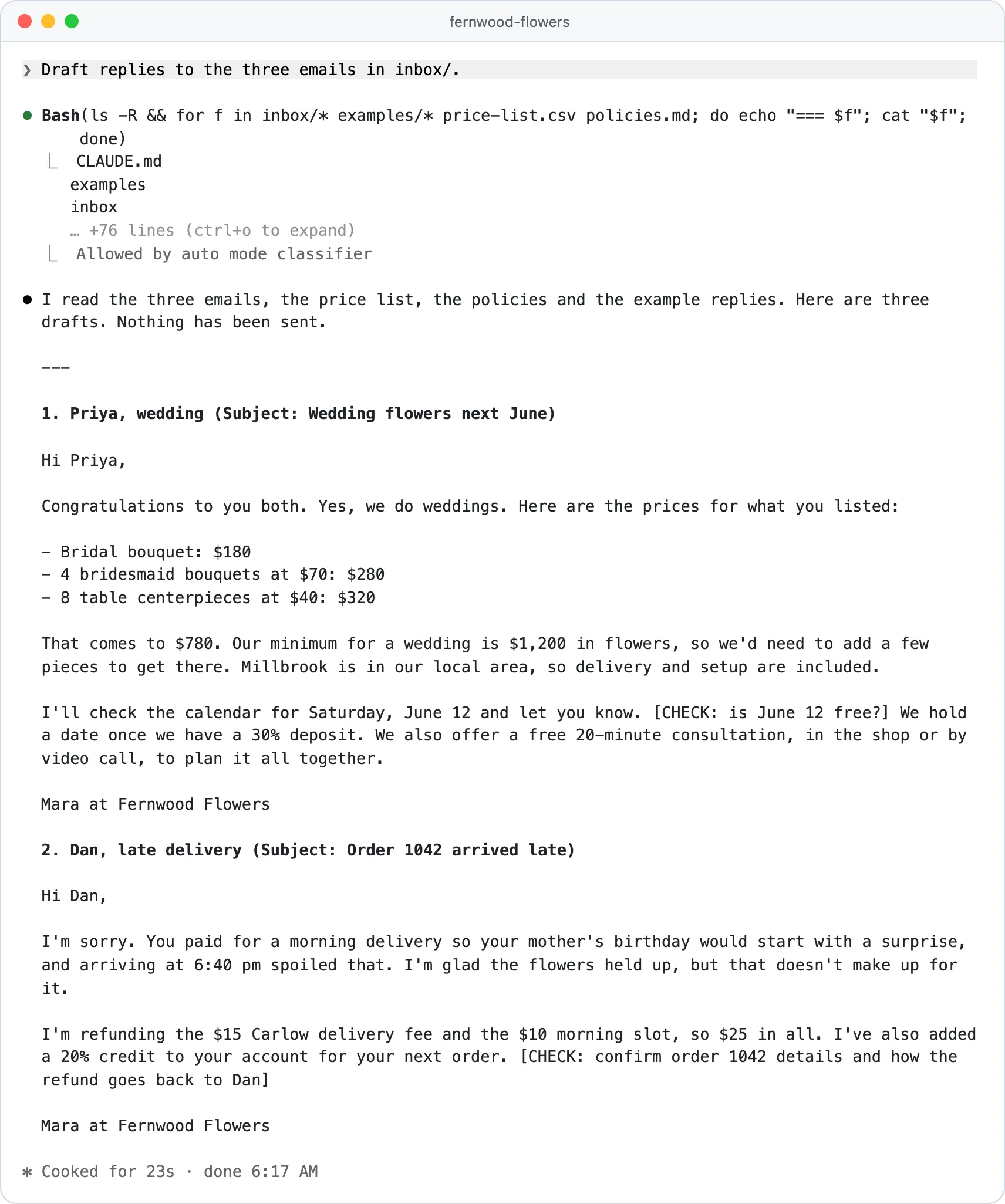
We ran each version three times to make sure this wasn't luck:
Our runs in Claude Code 2.1.303 with Claude Opus 5.5 on October 25, 2026, on the made-up Fernwood Flowers files. Scores per run: 0, 1 and 0; 6, 6 and 6; 12, 12 and 11 (one wedding reply ran 3 words over the limit).
words of business context in 6 small files
invented prices or policies in all 9 runs
seconds at most to draft all three replies, in any of the 9 runs
Measured from the session logs and Claude Code's own timer, October 25, 2026.
Two lessons for anyone shopping for a course. First, today's models rarely invent your prices when they don't know them; they leave blanks. So a course that spends hours on tricks against made-up answers is solving yesterday's problem. Second, wording took us from 0 to 6 checks and context took us from 6 to 12. A practical course has to teach both.
The syllabus checklist that follows
Tick these off against a course's lesson list before you pay:
0 of 7 done
Free prompting guides from OpenAI, Anthropic and Google
Before you pay for a course, read what the three companies themselves recommend. Each publishes a free prompting guide, kept up to date for its newest models, and they agree on more than they differ:
Anthropic
Prompting best practices: treat Claude like a brilliant new employee who lacks context, use 3 to 5 examples, and put long documents before your question, which Anthropic measured improving answers by up to 30%.
OpenAI
Prompting in ChatGPT: name the Goal, Context, Output and Boundaries, add only the sources that matter, and ask it to flag missing information instead of guessing.
Prompt design strategies: always include examples, keep their format consistent, give all the context first and the question at the very end.
These guides are references, not courses: no exercises, no feedback, no certificate. A course earns its price when it makes you apply them to your own work and checks the result.
How to check a prompt engineering course before you pay
Prompting advice has changed with the models, so an old course can teach habits that now backfire. Watch a free preview lesson and look for these signs:
- GPT-4o in the model picker: it left ChatGPT on February 13, 2026 (OpenAI's retirement notice), so those screens are older than that.
- A lesson that builds a custom GPT: personal plans can no longer create new ones, and custom GPTs retire on December 11, 2026 (OpenAI's FAQ).
- Rules shouted in capital letters: Anthropic's guide says recent Claude models respond more strongly to instructions, so "CRITICAL: you MUST" wording should be softened, not taught as a trick.
- Role-play and tag templates for every request: Anthropic's prompting post for 2026 calls heavy role prompting and XML tags less necessary with modern models.
- One prompt in an empty chat, lesson after lesson: no files, projects or saved instructions means the course skips the half that took our test from 6 to 12.
- A job title as the product: "become a prompt engineer" promises are a sales line, not a syllabus.
To test a specific course, paste its lesson list into the assistant you use:
I'm choosing a prompt engineering course. Here is its lesson list: [PASTE THE LESSON LIST]. It was last updated in [MONTH YEAR].
Facts as of October 2026: GPT-4o left ChatGPT on February 13, 2026, and custom GPTs retire on December 11, 2026. Anthropic and Google now advise softer wording instead of capital-letter rules, examples over long descriptions, and long documents before the question. Assistants keep standing instructions and files in projects, custom instructions or files such as CLAUDE.md.
List the lessons that are likely outdated, the lessons that still matter, whether I will practice giving the AI my own files and instructions, and 3 questions to ask the seller before I pay. I use [ASSISTANT] for [WHAT I DO AT WORK].
For warning signs that apply to any paid course, see our guide on whether AI courses are worth it.
Quick check0 of 3 correct
In our test, what moved the score from 6 to 12 checks out of 12?
Not quite.
The good prompt fixed the voice and length but could not supply prices or policies. The same one-line prompt passed all 12 checks once the shop's files were there.
A course sells an "official prompt engineering certification". What should you ask first?
Not quite.
OpenAI's and Anthropic's certifications are only open to invited companies or partner organizations, so anything sold to individuals is a course provider's own credential.
A course's lessons show GPT-4o in ChatGPT's model picker. What does that tell you?
Not quite.
OpenAI retired GPT-4o from ChatGPT on February 13, 2026, so any screen that still offers it is older than that.
What to do next
This week, pick one task you repeat, such as answering one kind of customer email, and run our three-version test on it with the scoring sheet in this guide's bonus. If a good prompt alone gets you most of the way, a free course and the official guides above are enough. If the version with your files wins by a wide margin, as it did for us, choose a course that teaches standing instructions, files and examples. Our Claude Code course, in early access, teaches that with CLAUDE.md files and skills on real business tasks, and our guide on how to learn AI has a 30-day plan to practice either way.
Prompt practice kit: the 12-check sheet and our test files
The scoring sheet from our test, the Fernwood Flowers files to repeat it, a seven-day plan to practice on your own work, and five questions to ask before you buy a course.
Enter your email and the full section opens right here. You also get a free lesson from the course.
Frequently asked questions
How long does it take to learn prompt engineering?
The basics take hours, not months: OpenAI Academy's AI Foundations takes about 70 minutes, and Google Prompting Essentials under 10 hours by Google's own estimate. Getting reliable results on your own work takes a few weeks of daily use, because most of the skill is learning what your tasks need the AI to know.
Do I need to know how to code to take a prompt engineering course?
No. Courses for everyday users, such as Google's Prompting Essentials or Vanderbilt's course on Coursera, work in the chat apps and need no code. A few well-known courses are written for developers, such as DeepLearning.AI's ChatGPT Prompt Engineering for Developers, which uses Python, so read the requirements before you enroll.
Which AI assistant should I practice prompt engineering on?
The one you will use at work, because the skills carry over. Anthropic, OpenAI and Google give nearly the same advice in their own prompting guides, and Claude, ChatGPT and Gemini all let you save standing instructions, so what you learn on one transfers to the others.
Is prompt engineering still worth learning in 2026?
Yes, as a work skill rather than a job title. Newer models need fewer tricks, so what pays off is a clear brief, good examples and the right files and instructions. Anthropic's own prompting post for 2026 calls prompt engineering a building block of context engineering.
What is the difference between a prompt engineering course and a general AI course?
A prompt engineering course teaches one skill: getting good results from an AI through how you instruct it and what you give it. A general AI course also covers what AI can do in your job, tools for images, video or automation, and safe use. New to AI? Start general. Already use ChatGPT or Claude every week? Prompting alone is enough.
Keep reading
How to Learn AI in 2026: A Free 30-Day Plan for Beginners
How to learn AI for free as a beginner, no coding needed: the AI skills to learn first, prompt and context engineering basics and a step-by-step 30-day plan.
Learn AI · 16 min readBest ChatGPT Courses (2026): Free, Paid and Up to Date
The best ChatGPT courses in October 2026: OpenAI Academy's free badges, whether a ChatGPT certification exists, and paid picks that teach ChatGPT Work.
Choosing an AI course · 15 min readGoogle AI Essentials Review: Is the Certificate Worth It?
Google AI Essentials review for 2026: what the 5 courses teach, $49 a month, about 8 hours, whether it's free and when the AI Professional Certificate wins.
Choosing an AI course · 12 min read